




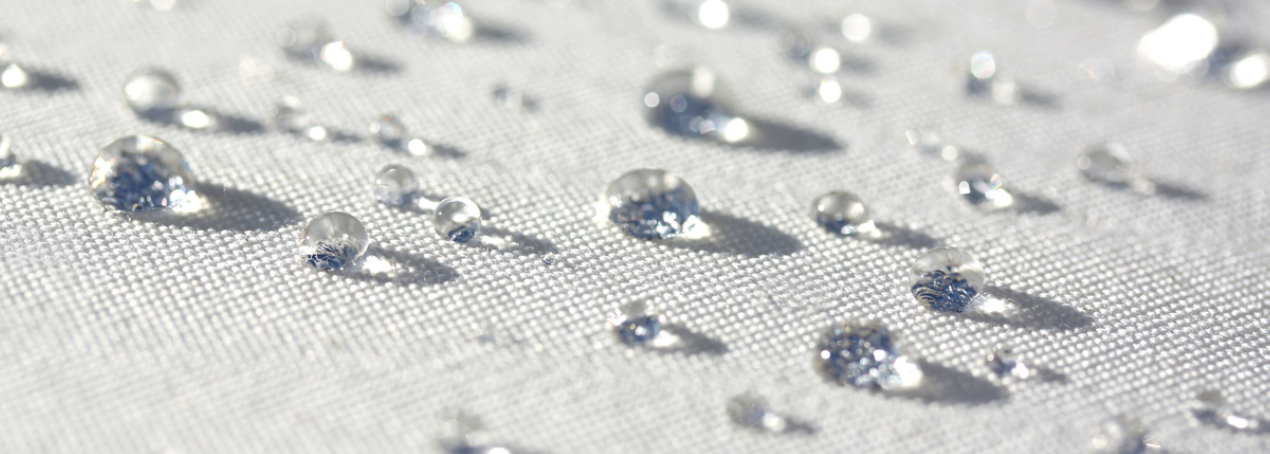
As EU regulations on PFAS tighten, the industry faces a critical question: can C0 DWR truly deliver the same protection in real-world conditions, or is "PFC-free" simply a compliance badge?
C6 vs. C0 DWR
For years, brands chose C6 DWR to meet the demanding performance requirements of outdoor apparel — valued for its water-repellent and oil-repellent properties, reliable wash durability, and straightforward finish recovery with low-temperature tumble drying.
Yet as the EU progressively restricts PFAS chemistry, C6 has shifted from "industry standard" to "unavoidable phase-out." PFC-free C0 DWR clears the compliance hurdle, but early-generation products were consistently criticized for poor water repellency, oil repellency, chalk mark formation, and poor compatibility with bonding constructions.
The question was never whether C0 could work; it was whether C0 technology had matured enough to deliver. Hwafune's answer is clear: C0 technology has reached an entirely new level.
Hwafune's C0 DWR Breakthroughs
Hwafune's R&D team identified the core pain points holding C0 back — durability, aesthetics, and bonding compatibility.
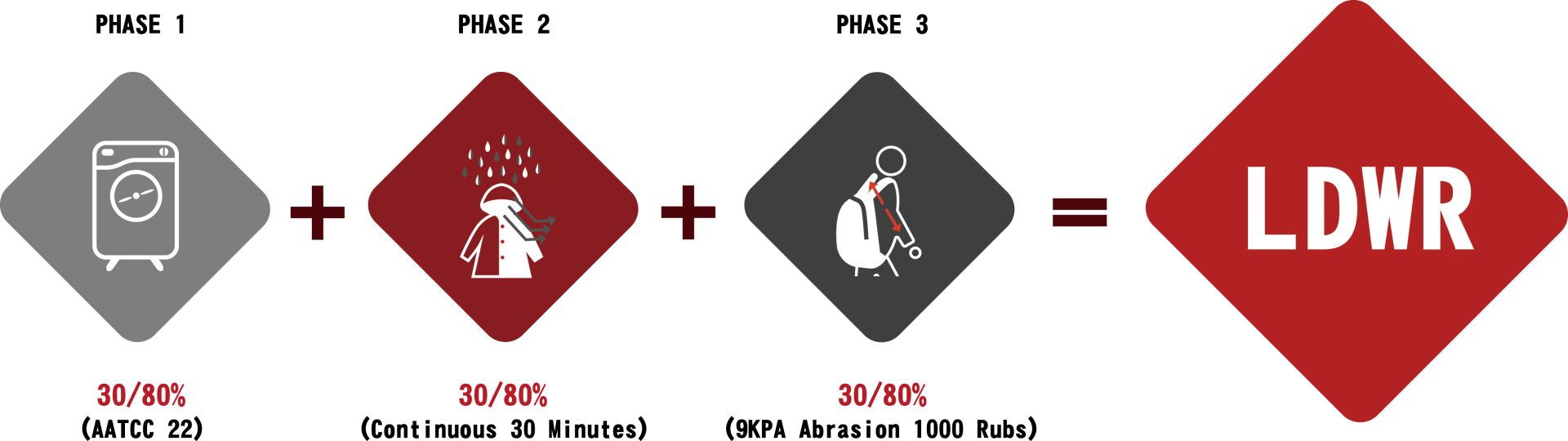
1、Exclusive LDWR Technology: Three-Stage Test
LDWR (Long Durable Water Repellent) is Hwafune's proprietary PFC-free C0 finish engineered for exceptional wash durability and functionality. It passes the following three-stage test while maintaining water repellency above 80% at each stage:
2、Eliminating Chalk Mark — Solving a Long-Standing Fabric Appearance Defect
Chalk mark, the white scuff-like streaking that appears on C0-treated fabrics under flexing and abrasion, has long been a critical quality barrier for finished garments.
Through a proprietary finishing process, Hwafune has significantly reduced chalk mark formation, bringing C0 functional fabrics to the same visual quality standard as C6-treated fabrics.
3、Bonding Compatibility — Solved
Transitioning from C6 to C0 is manageable for single-layer fabrics, but composite constructions (2L or 3L bonding) pose a well-known industry challenge.
Hwafune has systematically optimized its formulation across the most common bonding architectures on the market. Membrane-to-fabric adhesion remains stable after repeated washing and extended wear, showing no peeling or blistering.
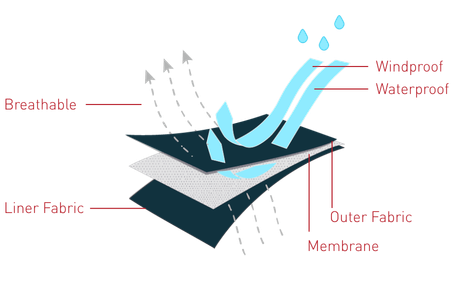
A Closer Look at LDWR: C0 Performance Backed by Data
Beyond the three-stage benchmark, Hwafune's R&D team has continued to push LDWR validation through internal and independent third-party testing.
(1) Internal testing · 80%+ repellency retained after 30 wash cycles (AATCC 22)
Internal data shows LDWR maintains water repellency above 80% after 30 wash cycles, far exceeding most commercial C0 products, which show significant degradation after just 10-15 washes, and positioning LDWR on par with or exceeding the wash durability of C6-treated fabrics.
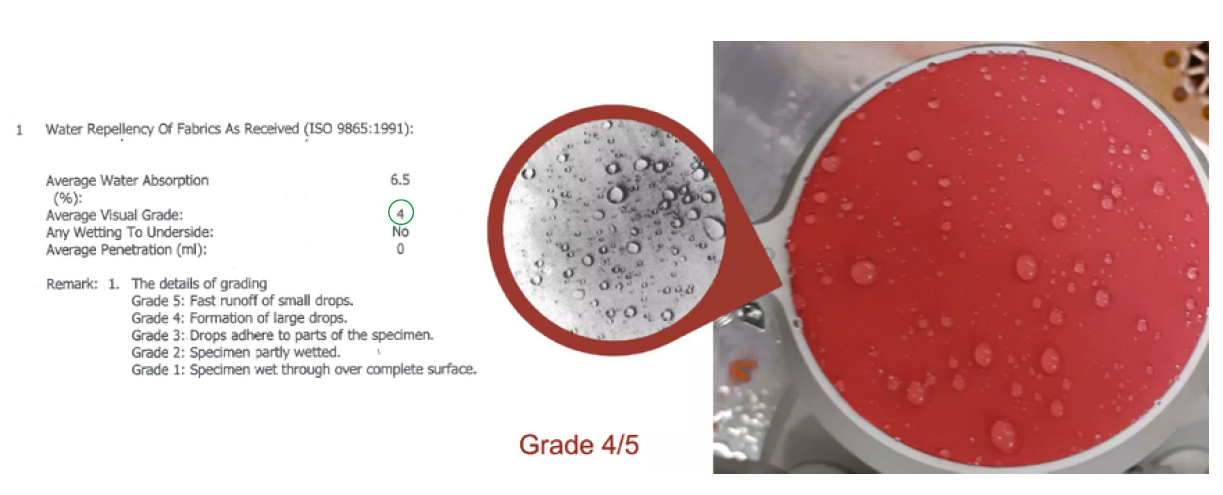
(2) Third-party certified · Bundesmann rain shower test (ISO 9865)
The Bundesmann rain shower test (ISO 9865) evaluates a fabric's water repellency under simulated rainfall and dynamic mechanical stress.
Fabric specimens are conditioned and weighed before testing. Water is then sprayed continuously onto the fabric face from above, while a mechanical wiper on the reverse side applies friction, replicating the physical stress of actual wear in rain.
After a set exposure period, the fabric is re-weighed, and the results are expressed as water absorption (%) and water penetration (ml). The lower both values, the more effective and durable the DWR finish.
Note: While LDWR demonstrates strong compatibility across a wide range of fabric constructions, final performance may vary depending on fabric structure, finishing conditions, and end-use requirements. Development-stage validation is recommended.
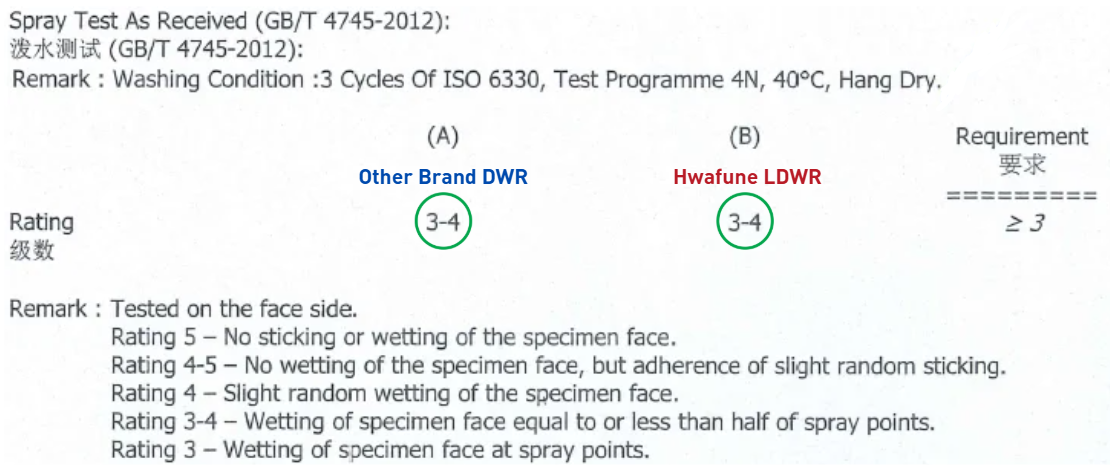
(3) Custom study · DWR recovery under hang-dry (no tumble dry) conditions
Conventional wisdom holds that DWR recovery after washing requires low-temperature tumble drying to reactivate. However, many end consumers hang-dry their garments and cannot rely on tumble drying.
In response to customer demand, Hwafune conducted a dedicated validation under pure hang-dry conditions with no external heat.
Results demonstrated that LDWR achieves repellency recovery under hang-dry conditions comparable to leading international DWR brands within the same performance tier, giving brands a reliable basis for care label guidance in hang-dry markets.
Conclusion: C0 is no longer a compromise — it's an upgrade
Hwafune's C0 LDWR technology is not a fluorine-free substitute; it is a redefinition of what C0 DWR can achieve. Selected test report summaries are available. Contact our sales team to request the complete dataset, fabric samples, or a technical presentation — and make your C6 → C0 transition with confidence.