
1. Home
  2. News
  3. 4 Functional Print Technologies That Your Consumers Will Actually Feel
news
2026 / 04 / 10
4 Functional Print Technologies That Your Consumers Will Actually Feel

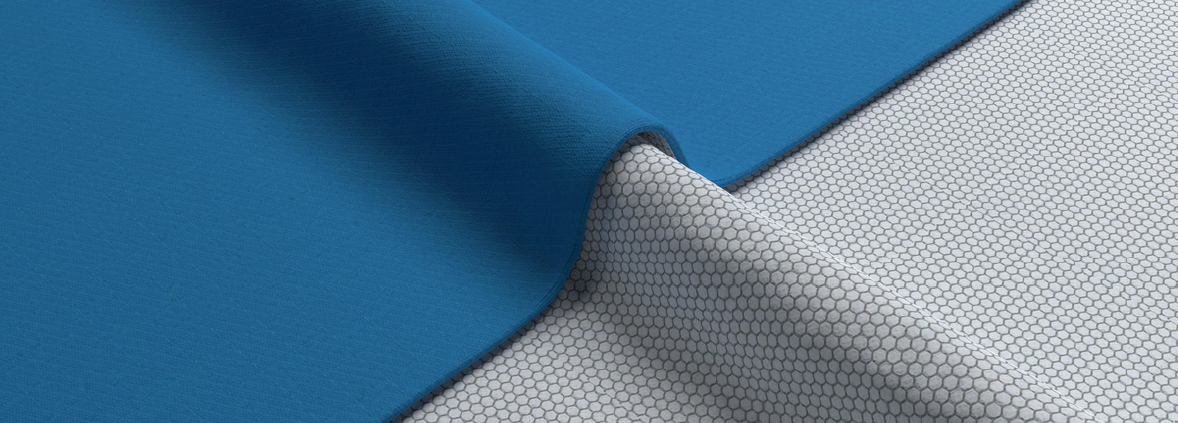
Hwafune membrane fabric with 3D structured honeycomb print for performance apparel

Picture yourself two hours into a trail, the rain has stopped, the sun is back, but your jacket stays trapped against your skin, damp, warm, and impossible to ignore. Now imagine that same moment, but the fabric breathes differently. It feels drier and cooler. That difference isn’t magic, it’s print.

At Hwafune, we believe the surface of a fabric isn't just decoration — it's performance. Below, we introduce four specialized print technologies designed to address real discomfort, from post-activity stickiness to cold-weather chill.

(1) Cellulose Print 

Designed for a Drier Feel

The earliest functional prints on membrane fabrics relied on coconut-shell carbon — effective, but coarse. Our Cellulose Print is a significant upgrade: a finer-particle formulation optimized for membrane surfaces, addressing the most persistent wearer’s complaint: the uncomfortable tackiness that lingers during and after physical activity.


Hwafune Cellulose Print and 3D Structured Print comparison showing enhanced airflow and dryness performance on membrane fabric How it works: The ultra-fine cellulose particles create a micro-textured surface layer that wicks perspiration away from the skin, reducing the wet skin-to-fabric contact area and delivering a noticeably drier feel.

(2) 3D Structured Print

Noticeably Drier, Textured

3D Structured Print shares the same core mission as Cellulose Print — reducing stickiness and improving dryness, but achieves this through a fundamentally different mechanism: physical architecture.

How it works: The raised relief pattern on the membrane surface creates deliberate air pockets between skin and fabric, promoting active air circulation and allowing heat and moisture to dissipate rather than accumulate.


(3) Cooling Print — Xylitol-Based

Inherent Cooling Comfort

Our Cooling Print is built on xylitol microcapsule technology, a moisture-activated cooling mechanism that works the moment your body needs it. The microcapsules lie dormant until triggered by perspiration. As the wearer sweats, the capsules release and dissolve, drawing heat away from the skin.
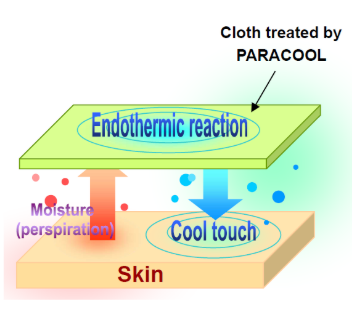
Diagram showing how Hwafune xylitol-based Cooling Print absorbs perspiration and triggers an endothermic reaction for a cool touch sensation on skin A hand was placed on the fabric sample for 3 minutes, and the thermographic image was recorded 1 minute later.
Thermographic comparison showing Hwafune xylitol-based Cooling Print reducing skin surface temperature versus untreated blank cloth


Indoors and outdoors: Xylitol carries a baseline cooling sensation even without active perspiration, making this print
effective in air-conditioned environments as well as outdoor conditions.

(4) Graphene Print

Engineered for Cold Conditions

Where the previous three technologies focus on cooling and dryness, Graphene Print addresses the opposite demand: warming performance in cold conditions.

By applying graphene in precise micro-quantities through our printing process, we preserve the original softness and drape of the base fabric. The warming effect is perceptible within 5 minutes, and the coating also provides antistatic properties, a valuable addition for cold-weather outdoor apparel.
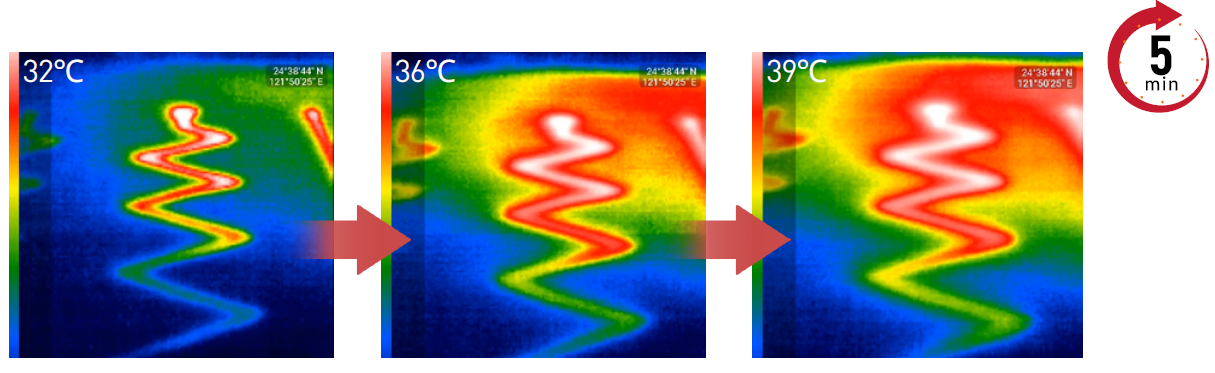
Thermographic sequence showing Graphene Print heating from 32°C to 39°C within 5 minutes, demonstrating rapid warming performance for cold-weather apparel